
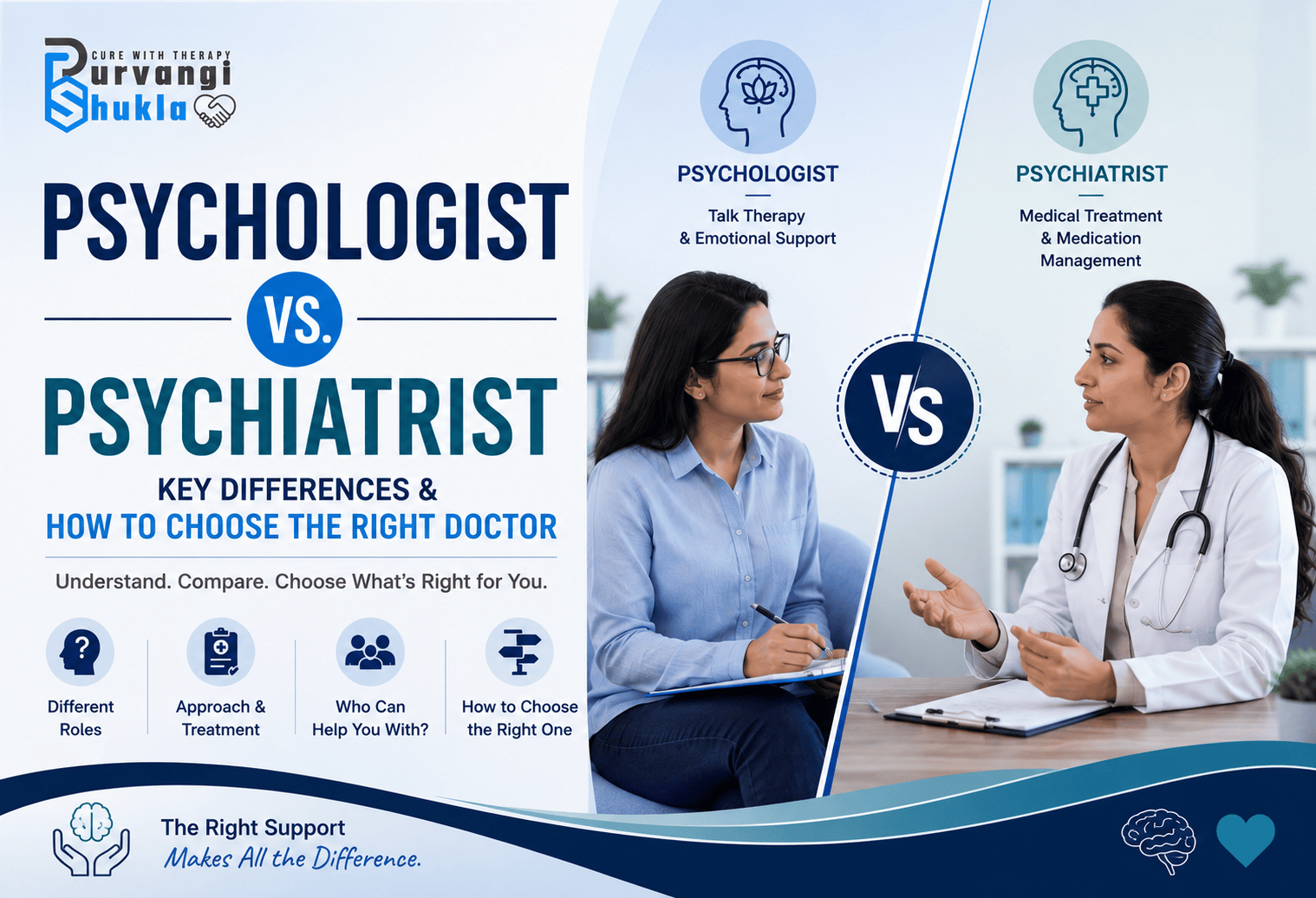
Are you confused about whom you have to consult? Psychiatrist or Psychologist?
Before that, understand what the key Difference Between a Psychologist and a Psychiatrist is.
Psychiatrist
Taking a medical degree in MBBS and then doing a postgraduate specialisation in psychiatry – either an MD (Doctor of Medicine) in Psychiatry or a Diploma in Psychological Medicine (DPM). In India, this means a minimum of nine years of medical education and clinical training after Class 12.
A psychiatrist is a fully qualified doctor who treats
- Diagnoses medical conditions through mental and biological ways
- Prescribes medicines to cure mental disorders based on the diagnoses
- Investigates through blood tests, EEG, and brain scans
- Finds other conditions, such as neurological and biological conditions, that cause mental health issues
- Manages severe mental health issues that require hospitalisations.
- Manages mental health through medications and hospitalisations
Psychologist
A psychologist holds a postgraduate degree in psychology – typically an MA, MSc, or MPhil in Clinical Psychology, or a PhD. In India, a Rehabilitation Council of India (RCI)-recognised qualification in clinical psychology is the standard for practice, with 7-year training programs.
A Psychologist gets training and treatment in
- Conducts Psychological testing and assessments with psychometric testing
- Provides structured Psychotherapies like as CBT, DBT, EMDR, Exposure Therapy, etc.
- Understands human behaviours, cognitions, experiences and personalities
- Works with Individuals, groups, organisations, couples and families
- Takes Case history and Mental Status Examination, which decides the structure of sessions.
In India, there is one difference: a psychologist does not prescribe medicine, and that is the only major difference between a psychologist and a psychiatrist.
It is the biggest dilemma: whom to see first, a Psychologist or A Psychiatrist.
The condition and severity of the mental state are key factors in deciding whom to seek first. In many cases, behavioural and cognitive changes may indicate a mental state and do not require medication. In some cases, both medications and therapies are needed; hence, consulting both professionals is advisable.
See a psychiatrist first if:
- If your symptoms are so hard to manage that they affect your sleep, appetite and daily functioning.
- If you are facing severe panic attacks or mood swings and thoughts of self-harm.
- When your symptoms are challenging, and you feel that you require medical support for the same.
See a Psychologist first if:
- If you have mild to moderate stress, anxiety and mood swings issues.
- If you want to learn to cope with mental health issues without medications.
- If you want to learn new behaviours to deal with stress, anxiety, and depression.
- To deal with triggers and also with past grief, trauma, or to manage cognitive biases.
- Talk therapies are so helpful when you understand your key areas of difficulty, and you get various ways to manage them.
A common misconception in India:
To visit a mental health professional is still taboo for many people in India. They feel like, “kya main pagal hoon?” “Am I really mad?” but that is not the truth. It is as simple as seeking a doctor when you are physically unfit. In the same way, you seek professionals when you are not feeling okay emotionally or mentally. Have an attitude that it’s okay to see mental health professionals as well.
There is a similar conception with medicine as well. Am I so seriously ill that I need medications? But that is not correct. Taking medicine does not mean you are very ill; it does not prove that. Many people have a hard time seeing a psychiatrist due to these challenges and sabotaging thoughts in their minds.
What does a Psychiatrist treat?
- Depression – Moderate to severe cases and treatment-resistant people
- Anxiety disorders – GAD (Generalised Anxiety, Agoraphobia, Social Anxiety etc.)
- Bipolar Disorder – Mood Stabilisers and antipsychotic medications
- Obsessive-Compulsive Disorder (OCD) – requires treatment with both medicines and therapies
- Schizophrenia and psychotic disorders – require antipsychotic medication
- ADHD – diagnosis and medication management in children and adults with therapies
- Addiction and substance use disorders – require medicinal treatments
- Eating disorders
- Sleep disorders – insomnia, hypersomnia, and sleep-related conditions
- Dementia and neurocognitive disorders
- Postpartum psychiatric conditions
What does a Psychologist do?
- Mild to moderate depression, as well as severe symptoms, with medication prescribed by a psychiatrist.
- OCD (Obsessive-Compulsive Disorder) with CBT, DBT, and exposure therapies
- Interpersonal and intrapersonal relationship therapies.
- Grief and trauma-related therapies, Post-Traumatic Stress Disorders
- Behavioural therapies to cope with the triggering emotions
- Family and Relationship therapies
- Marital counsellings
- Family therapies to improve Quality of Life with mental disorders
- Psychological Assessments
- Psychoanalyses and Psychotherapies
- Stress management and coping skills
- Cognitive Behaviour Therapy
Summary of the difference between a Psychologist and a Psychiatrist.
| Psychiatrist | Psychologist | |
| Who will prescribe medicine? | A Psychiatrist | – |
| Can a psychiatrist does therapy? | Some | All |
| Are they work together? | Yes | Yes |
| In severe symptoms whom to contact first? | A Psychiatrist | – |
| For therapies life CBT or Psychotherapies whom to contact? | – | A Psychologist |
Psychologist or Psychiatrist Which is Better?
Many people wonder whether a psychologist or a psychiatrist is better for mental health concerns. The answer depends on your needs.
A psychologist specializes in counseling, psychotherapy, psychological assessments, and behavior change techniques. They help individuals manage stress, anxiety, depression, relationship issues, overthinking, trauma, and emotional difficulties through evidence-based therapies.
A psychiatrist is a medical doctor who specializes in diagnosing and treating mental health disorders. Psychiatrists can prescribe medications and are often consulted for conditions such as severe depression, bipolar disorder, schizophrenia, panic disorder, and other complex mental health conditions.
Neither is universally better than the other. If you are seeking therapy, emotional support, and coping strategies, a psychologist may be the right choice. If your condition requires medical evaluation or medication, a psychiatrist may be more appropriate. In many cases, psychologists and psychiatrists work together to provide comprehensive mental health care.
The best choice depends on the nature and severity of your concerns and the type of support you need.
