
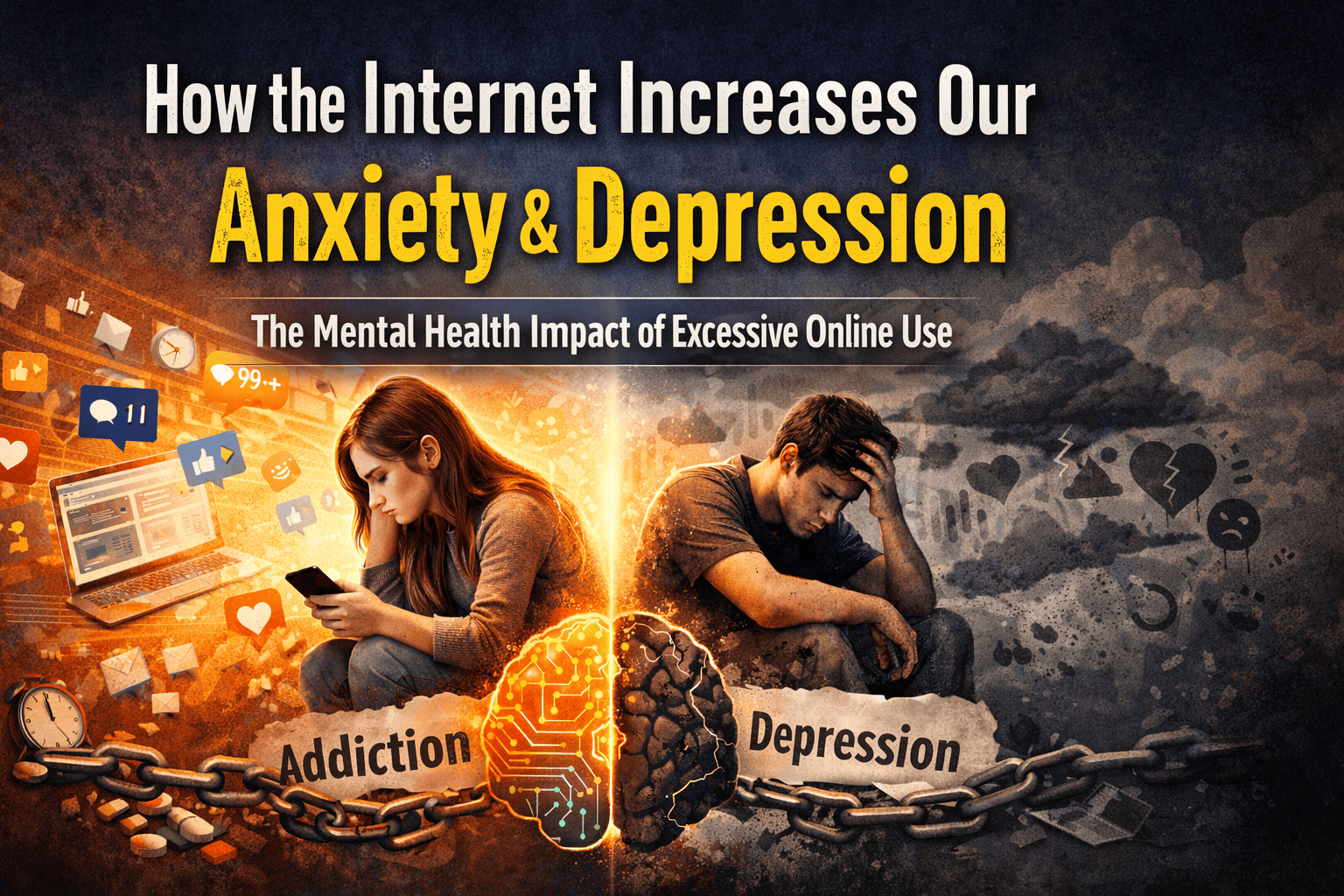
“We know all the information, but we don’t understand either.” Today, we are all in the most developed Human Era. Material life has played the biggest role in our lives.
And we connect in fractions of a second. But can we foresee our future? Can we see how our psychology is affected by watching Reels, sticking to the white screen, and always being eager to know what is new? The Internet has also improved our lives.
And these blessings are now becoming a cure for all humanity, especially the next generation. Let’s understand that today, the high usage of the Internet creates Anxiety and Depression.

Why is high internet usage responsible for Anxiety?
Before we dig into the concept of Internet use and its relationship with Anxiety, let’s self-assess first.
Rate the questions below on a scale of 0 to 5 and understand where you are.
- How many times are you busy scrolling and postponing your important work or studies?
- How many times have you been worried that you need to communicate in social gatherings?
- How many times do you find yourself imagining Internet stuff when you’re offline?
- How many times are you lying or hiding your internet usage from others?
- How many times are you comfortable in communication with a virtual friend but afraid of a physical friend?
- How many times are you distracted from your important job by watching something online?
- Do you lose your sleep while you are online?
- How many times are you unaware of your time while binge-watching on the Internet?
- How many times do you avoid going out with your loved one because you want to use the Internet?
- How many times have you been frightened by the thought of life without the Internet?
If you score between 40 and 50, you have high Internet usage. Less than 40 and above 30 moderate, and between 20 and 30 moderate to mild.
Circle of Internet Usage and Anxiety
The cycle below is very useful to understand why High Internet usage increases our Anxiety and leads to Depression.
Productive Time with Internet Usage
The Internet is accessible to everyone, everywhere, with no restrictions on time or place. Exceptional to the rules made by some organisations and institutes. Internet usage during work or studies kills time but makes one less attentive to tasks. More engrossed in the completion of work, not the productivity of the work. Being more engaged in completion than in productivity leads to low-quality work. When someone chooses not to use the Internet at work, it feels like such a sacrifice, and they expect more results from the tasks they did. When shallow productivity expects deep results, people become more anxious as they overthink doing more than is required, even though the desired results are impossible. These distorting thoughts distance one from productivity, leading to excessive Internet use.
Lack of Attention Span
Productivity is achieved through persistent, consistent work. Doing the same tasks over and over, you become a master. But when attention is focused on completing tasks and achieving high results, attention to detail suffers. Because all focus is on results, not on actions. When actions are shallow, results are also shallow. When you do tasks as required, you can’t become an expert, as the basics aren’t clear. This leads to a lack of attention at work and a feeling of low confidence, Anxiety about fears and results, which results in overthinking.
Rush to meet the deadline.
Postponement is commonly researched among high Internet users. They are more into virtual connections and entertaining themselves, seeking new information, but which is of no use, and are anxious about what is next. These are thoughts commonly found among users as their impulsivity increases, leading them to seek pleasure and avoid productive tasks. Now, when someone wants to meet a deadline, it is the only task. They believe in meeting the date, not the qualitative work. Rushing to meet the deadline only feeds more Anxiety about missing it.
Self-Negative Reflection.
When one is unproductive and unable to perform as one should, one feels empty about oneself. They frequently meet failures, miss their promises, and regularly miss deadlines; they feel like failures. On top of that, more hitting points when family and mentors share negative feedback about non-productivity and lack of effort, added to self-negative reflections. Reflections are correct, but increase more overthinking and Anxiety. It is hard for someone who feels negative about themselves to maintain a routine. Such scenarios can make a person feel depressed or rebellious in their own actions.
Future Prediction
With the lack of routine, one can imagine his life as dark, like an all-or-nothing feeling. Slowly, you found that everything was meaningless and worthless. There is no hope for the future, and you cannot see any future. You predict that, no matter what you do, you won’t achieve the desired results. You will gradually become negative about your productivity, feeling like you’re losing your job or scoring low in your studies. When you reach to the saturation point and believe that the desired results will not be achieved, you choose not to act, which proves your belief is correct. (Negative Conceptual Cycle as per Cognitive Psychology)
Need Distraction
To get rid of negative overthinking and future prediction, you need some distractions. This distraction is nothing but the Internet again. You again chose to go online, watch a binge, and avoid and ignore your core thoughts. You avoid thinking about your actions and completing tasks until it gets worse. This cycle is unbroken and keeps you in this roller coaster, increasing your panic, Anxiety, worries and overthinking, which leads to Depression.
How Counselling help to overcome…
Psychoeducation sessions help to reduce Internet usage, and various other therapies help to navigate this maladaptive behaviour. Cognitive Behaviour Therapy helps correct dysfunctional beliefs and thoughts, and rectify behaviours. Interpersonal therapy helps identify what needs to be done and which aspects are dysfunctional. Dialectical Behaviour Therapy helps install new behaviours and achieve positive results.